How to Calculate Sales Tax on Multiple Items (Receipt Example)
Calculate tax on a full receipt: add up the taxable items, apply the rate, and see why the total can differ by a cent from the store's line-by-line method.
A receipt with several items is not harder than a single price, but two things can change the answer: some items may not be taxable, and the tax can be rounded per item or on the whole receipt.
Method 1: tax on the taxable subtotal
If you need a refresher on the basic formula, read how to calculate sales tax.
- Add up the prices of the taxable items.
- Multiply that subtotal by the tax rate.
- Add the tax to the full receipt total.
Want to try it right away? Sales Tax Calculator is free and needs no signup.
A receipt example at 7%
| Item | Price | Taxable? |
|---|---|---|
| Shirt | $24.99 | Yes |
| Notebook | $4.50 | Yes |
| Groceries | $18.20 | No (in this example) |
| Headphones | $59.00 | Yes |
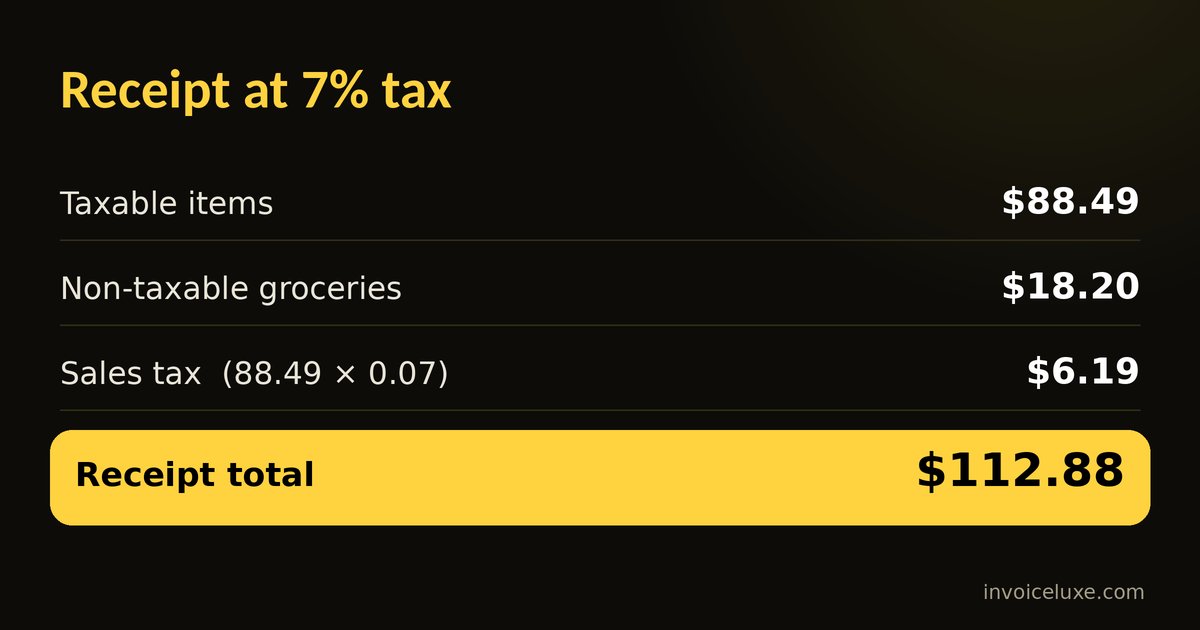
- Taxable subtotal: 24.99 + 4.50 + 59.00 = $88.49
- Sales tax: 88.49 × 0.07 = 6.1943, which rounds to $6.19
- Receipt subtotal: 24.99 + 4.50 + 18.20 + 59.00 = $106.69
- Total: $106.69 + $6.19 = $112.88
Whether groceries are taxed depends on the state, so use your state's rules for your own receipts.
Method 2: tax on each line
Some point-of-sale systems calculate the tax on every item and add the results.
| Item | Price | Tax at 7% (rounded) |
|---|---|---|
| Shirt | $24.99 | $1.75 |
| Notebook | $4.50 | $0.32 |
| Headphones | $59.00 | $4.13 |
| Total tax | $6.20 |
That is one cent more than Method 1. Rounding each line to the cent first causes small differences. Neither is a mistake. The method depends on the store's system and local rules.
What to use for your own invoices
Pick one method and use it on every invoice, so your totals are consistent. Many businesses calculate tax on the invoice subtotal, which is Method 1. Use a calculator that lets you enter the amounts and the rate, and keep taxable and non-taxable items separate.
FAQ
Do I calculate tax on each item or on the total?
Both are used. Calculating on the taxable subtotal is simpler and gives fewer rounding differences.
What if some items are tax-exempt?
Leave them out of the taxable subtotal, then add them to the receipt total afterward.
Why is my receipt one cent different from my calculation?
The store probably rounded the tax line by line. Compare both methods to see the difference.
Is this tax advice?
No. It explains the math. Which items are taxable depends on your state.