 Invoice Luxe
How to Find the Original Price Before a Discount
Work backwards from a sale price to the original price with one division. Includes examples at 15%, 20% and 30% off, and why adding the percentage back is wrong.

You know what you paid and how much the discount was, and you want to know what the price was before the sale. The answer is one division.
Original price = sale price ÷ (1 − discount rate)
Worked examples
| Sale price | Discount | Calculation | Original price |
|---|---|---|---|
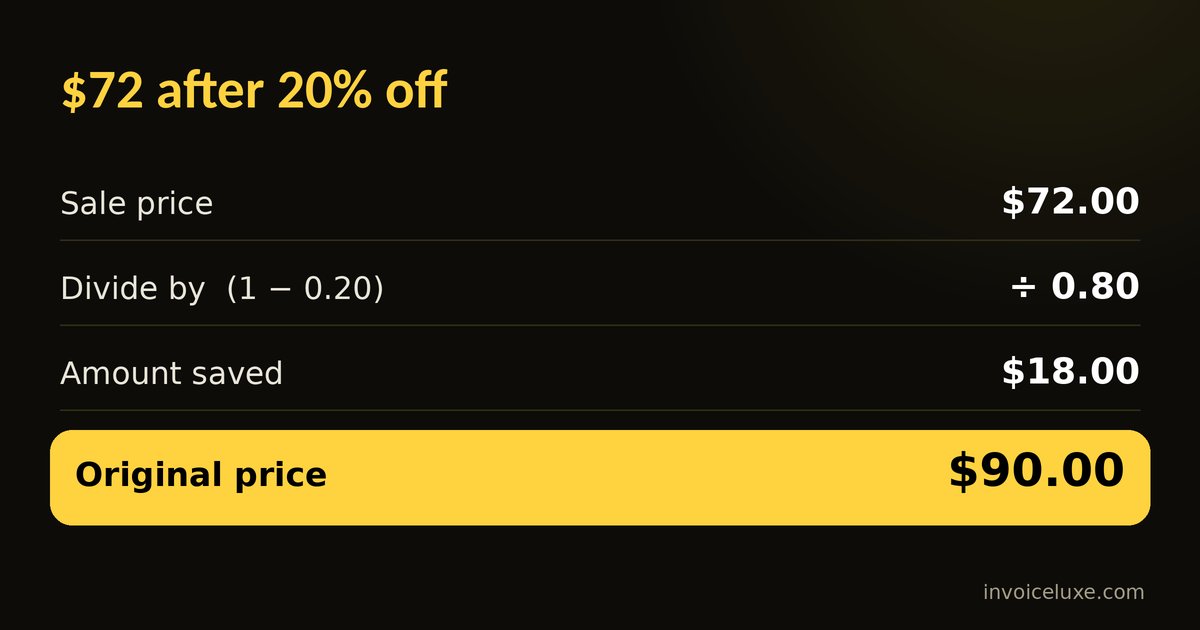
| $72.00 | 20% | 72 ÷ 0.80 | $90.00 |
| $59.50 | 15% | 59.50 ÷ 0.85 | $70.00 |
| $39.99 | 30% | 39.99 ÷ 0.70 | $57.13 |
For the last row, 39.99 ÷ 0.70 = 57.1285, which rounds to $57.13.
Want to try it right away? Discount Calculator is free and needs no signup.
Why you cannot just add the percentage back
If an item cost $72 after 20% off, you might add 20% to get $72 × 1.20 = $86.40. That is wrong, because the 20% was taken from the original price, not from $72.
- Wrong: 72 × 1.20 = $86.40
- Right: 72 ÷ 0.80 = $90.00
Check: 20% of $90 is $18, and $90 − $18 = $72.
Step by step
- Convert the discount to a decimal (20% becomes 0.20).
- Subtract it from 1 (1 − 0.20 = 0.80).
- Divide the sale price by that number.
Where this is useful
- Checking whether a "was" price on a sale tag is believable.
- Finding the list price when you only have a receipt.
- Recording an item's full price in your inventory or books.
- Working out how much margin a discount used up.
Find the discount if you know both prices
If you have both the original and the sale price, the discount percentage is (original − sale) ÷ original × 100. For $90 and $72, that is 18 ÷ 90 = 20%.
Check your result with a calculator
Enter the original price you found and the discount rate in a discount calculator. If it returns your sale price, your answer is right.
FAQ
How do I find the original price from a 25% discount?
Divide the sale price by 0.75.
How do I find the original price after a 50% discount?
Divide by 0.50, which means doubling the sale price.
Does sales tax change this calculation?
Remove the sales tax first by dividing the receipt total by 1 plus the tax rate. Then use the discount formula on the pre-tax price.
Why is my answer a few cents off?
Prices are rounded to the cent, so the original price you find may differ by a cent or so from the real tag price.