 Invoice Luxe
Markup vs Discount: Why 20% Off Isn't 20% Back
A 20% markup followed by a 20% discount does not return to the original price. See the maths and how to price discounts safely.

Add 20% to a price, then take 20% off. Do you get back to where you started? No, and the gap can cost you money.
The reason is that the two percentages apply to different amounts.

What happens when you add and remove 20%?
- Cost price: $100
- Add a 20% markup: 100 × 1.20 = $120
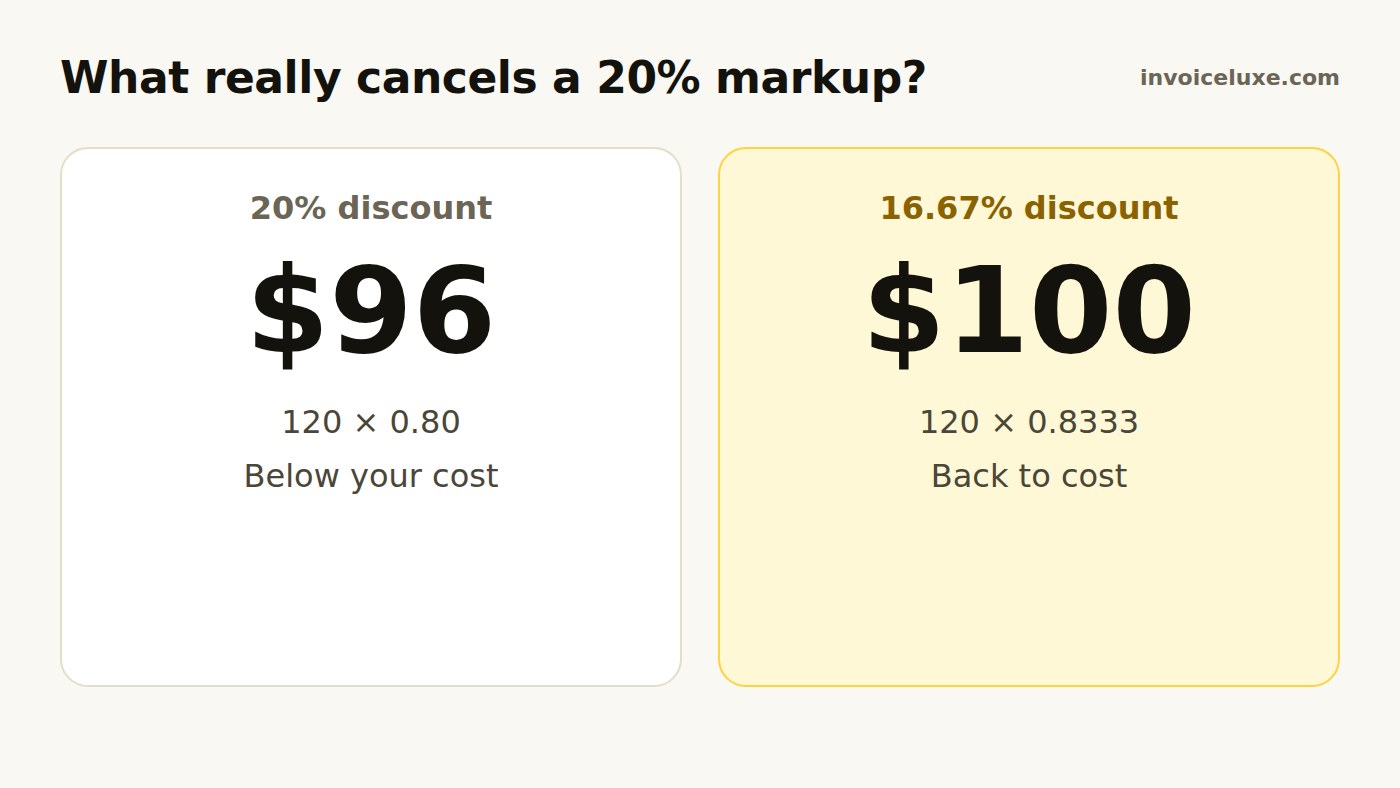
- Give a 20% discount: 120 × 0.80 = $96
You end up $4 below your cost. The discount was 20% of the bigger $120, so it removed more than the markup added.
Want to try it right away? Discount Calculator is free and needs no signup.
What discount cancels a markup exactly?
Discount that returns to cost = markup ÷ (1 + markup)
| Markup | Discount to return to cost |
|---|---|
| 10% | 9.09% |
| 20% | 16.67% |
| 25% | 20% |
| 50% | 33.33% |
So after a 20% markup, a discount of 16.67% brings the price back to $100.
How do you price a sale safely?
- Decide the lowest price you can accept first.
- Work backwards: a $120 price with a 15% discount gives $102, still above the $100 cost.
- Remember that margin is not markup. A 20% markup is a 16.67% margin on the selling price.
Use the calculators
Use the discount calculator to see the price after a percentage off. For margins and markup, try the profit margin calculator. To go deeper on percentages, read how to calculate a discount percentage.
FAQ
Does a 20% discount cancel a 20% markup?
No. A 20% discount on the marked-up price leaves you below your original cost.
What discount cancels a 20% markup?
About 16.67%, which is 20 ÷ 120.
What is the difference between markup and margin?
Markup is profit as a percentage of cost. Margin is profit as a percentage of the selling price.
Is this financial advice?
No. It explains the calculation. Check your own costs before setting prices.