 Invoice Luxe
7 VAT Calculation Mistakes (Are You Making Them?)
The most common VAT calculation mistakes on invoices and prices, with examples and the correct method. Check whether you are adding, removing or rounding VAT wrongly.
VAT mistakes are easy to make and easy to miss, because the numbers often look almost right. These seven are the most common. Check your own invoices against them.
Quick test: if you remove VAT by subtracting a percentage of the total, you are probably making mistake number 1.
1. Subtracting 20% instead of dividing by 1.20
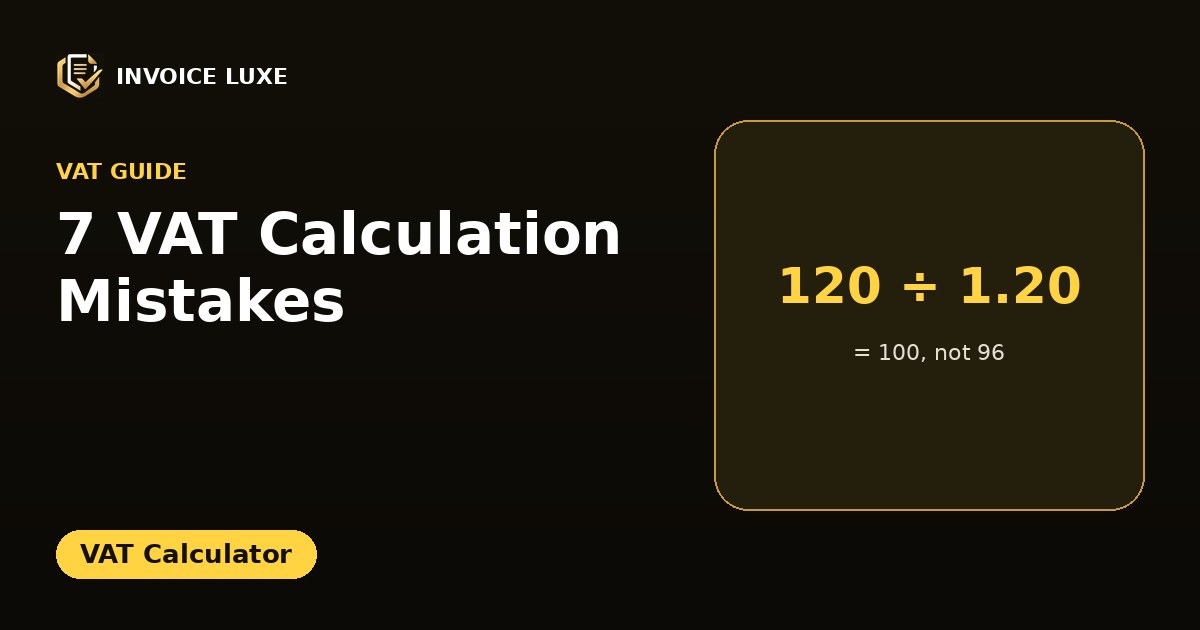
A price including 20% VAT is £120. Many people take 20% off: 120 − 24 = £96. That is wrong. The correct net price is 120 ÷ 1.20 = £100. The VAT is £20. See how to calculate VAT backwards.
Want to try it right away? VAT Calculator is free and needs no signup.
2. Calculating VAT on the gross price
VAT is calculated on the net price. If an item costs £100 before VAT, the VAT at 20% is £20. Applying 20% to a price that already includes VAT gives £24, which is too much.
3. Mixing up VAT rates
Some items are standard rated, some reduced and some zero rated. Using one rate for everything on an invoice overcharges or undercharges. Check the rate for each line.
4. Applying a discount after VAT
Normally you discount the net price first and then add VAT. On £200 net with a 10% discount and 20% VAT: 200 − 20 = 180, VAT 36, total £216. If you add VAT first and then discount, the total can look the same, but the VAT amount shown on the invoice will be wrong. Read discount and sales tax together.
5. Inconsistent rounding
Rounding each line and then adding gives a slightly different total than adding the lines and rounding once. Pick one method, apply it consistently and make sure the invoice adds up.
| Method | Example (3 lines of £3.33 net at 20%) |
|---|---|
| Round each line | 3 × £4.00 = £12.00 |
| Round the total | £9.99 × 1.20 = £11.99 |
6. Leaving out required details
A VAT invoice normally needs your VAT number, the customer details where required, the date, a description and the VAT amount. See what to include on a VAT invoice.
7. Charging VAT when you should not (or the reverse)
Rules for cross-border sales, exemptions and registration thresholds vary. If you are unsure whether to charge VAT, ask your tax authority or an accountant rather than guessing.
Use a calculator to avoid errors
A VAT calculator adds or removes VAT correctly and shows the net, VAT and gross at once, so you can double-check your invoices.
FAQ
What is the most common VAT mistake?
Removing VAT by subtracting the percentage of the gross price instead of dividing by 1 plus the rate.
How do I calculate 20% VAT correctly?
Net × 0.20 is the VAT, and net × 1.20 is the gross price.
Is VAT calculated before or after a discount?
Normally after the discount, on the reduced net price. Check the rules that apply to your situation.
Is this tax advice?
No. It explains common calculation errors. For your own VAT obligations, check with your tax authority or an accountant.